
Showing posts with label Tim. Show all posts
Showing posts with label Tim. Show all posts
Friday, April 22, 2011
Global radiative forcing from contrail cirrus

Strange Spring: Explaining This Year's Wild Weather

This season's higher-than-normal highs, lower-than-normal lows and extreme storms are, to some degree, symptoms of what tends to be a volatile time of year. But there are also some more insidious factors behind the latest round of weather grief, including an unusually strong La Niña, a strange pocket of warm air in Arctic, and overall climate warming.
Tuesday, April 19, 2011
Some Arctic Coasts Eroding by a Hundred Feet a Year

Since 2000, dozens of scientists have recorded an average annual erosion rate of about 1.6 feet (0.5 meter) of permafrost—or frozen soil—while studying some 62,000 miles (100,000 kilometers) of coast. That's about 25 percent of the total Arctic coastline.
Monday, April 18, 2011
Fossil-fuel will dominate even in 2030: ExxonMobil

There is bad news for those determined to tackle global warming. No matter how desperately the world wants to reduce carbon emissions through a cut in fossil-fuel consumption, it seems an inescapable fact that such fuels will continue dominating global energy demand 20 years from now.
Monday, April 11, 2011
In the Mountains of Patagonia, a Harbinger of a Rising Ocean

On Sunday, a group of British and Swedish scientists published new calculations for the great ice fields of Patagonia, the southernmost section of South America. They were able to map out the maximum extent reached by glaciers and ice caps in the region during a cold period known as the Little Ice Age, which ran from the 16th to the 19th centuries.
U.N. Goal of Limiting Global Warming Is Nearly Impossible, Researchers Say

International negotiators at a United Nations-sponsored climate conference ending today in Bangkok repeatedly underscored the goal of keeping the amount of global warming in this century to no more than 2˚C. But results from a Canadian government climate modeling study published last month suggest that “it is unlikely that warming can be limited to the 2˚C target,” the scientists who wrote the study say.
The paper finds that reaching that goal would require that greenhouse emissions “ramp down to zero immediately” and that scientists deploy means, starting in 2050, to actively remove greenhouse gases from the atmosphere. Previous modeling efforts have already highlighted the difficulty of reaching the 2˚C goal. But the new study is unique in several ways. Most important, it relies on the first published results from the latest generation of so-called Earth System climate models, complex programs that run on supercomputers and seek to simulate the planet’s oceans, land, ice, and atmosphere. The model in this study, Canadian Earth System Model 2, also incorporates updated data on volcanic eruptions, and it simulates in a more sophisticated way the biosphere’s ability to take in or emit carbon.
Monday, April 4, 2011
The Truth, Still Inconvenient

But the joke actually ended up being on the Republicans, when one of the two actual scientists they invited to testify went off script.
Prof. Richard Muller of Berkeley, a physicist who has gotten into the climate skeptic game, has been leading the Berkeley Earth Surface Temperature project, an effort partially financed by none other than the Koch foundation. And climate deniers — who claim that researchers at NASA and other groups analyzing climate trends have massaged and distorted the data — had been hoping that the Berkeley project would conclude that global warming is a myth.
Wet Winter Can't Slake West's Thirst
BOULDER CITY, Nev.—For the 30 million Americans who depend on the Colorado River for their water, this past winter's soaking rains and snows will only leave them thirsting for more.
 Water managers warn that Lake Mead, the West's largest and most important reservoir, remains perilously near the level of 1,075 feet at which the U.S. Secretary of the Interior would likely declare a water shortage, for the first time in the nearly century-old history of the Colorado River system. Such a shortage would parch Nevada, Arizona and California with severe water-use restrictions. There alone, some 20 million people depend on Lake Mead's supplies.
Wednesday, March 23, 2011
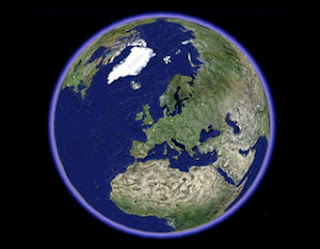
Google Takes on Climate Change Skeptics with New Technology Effort
Kelly Levin, a senior research associate at the World Resources Institute, a conservation group, said she hoped the Google program could tackle that challenge by engaging wider audiences in the scientific discussion.
Monday, March 21, 2011
Is Coagulation Geoengineering's Achilles' Heel?

English: There is more acceptance of studying it in just the last couple of years. I think scientists are facing the reality that countries aren’t doing much to slow the emissions of greenhouse gases. Eventually, we may have to choose between the risks and consequences of climate change and the risks and consequences of climate engineering. The only way to make an educated decision about that is to study it.
“Plume of unknown etiology” moving over Alaska

When viewed from a more western angle using MTSAT-2 0.73 µm visible channel images (below; click image to play animation), the plume feature (which can be seen moving over far northwestern Alaska in the upper right portion of the images) also exhibited a darker appearance, similar to that seen on the GOES-11 visible imagery. This darker appearance was due to backward scattering of light from the particles within the plume.
Arctic Ozone Thins

“This is pretty sudden and unusual,” said Bryan Johnson, a research chemist in the Global Monitoring Division of NOAA’s Earth System Laboratory (ESRL) in Boulder, Colo., and leader of ESRL’s Ozonesonde Group.
The stratospheric ozone layer protects Earth from damaging ultraviolet radiation, but chlorine and bromine from air pollutants such as chlorofluorocarbons and similar compounds can eat away at ozone in the right conditions: Temperatures below -78C (cold enough to form nitric acid-containing ice crystals in the relatively dry atmosphere) and sunlight (to trigger chemical reactions on ice surfaces).
Friday, March 11, 2011
Climate researchers: Deadly Russian heat wave was natural

"We may be on the cusp of a period in which the probability of such events increases rapidly, due primarily to the influence of projected increases in greenhouse gas concentrations," said the team led by Randall Dole and Martin Hoerling of the U.S. National Oceanic and Atmospheric Administration.
Climate change threatens Great Lakes

Polar ice loss quickens, raising seas
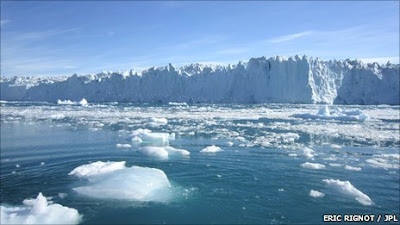
Overall, sea levels are rising by about 3mm (0.12 inches) per year.
Writing in Geophysical Research Letters, the team says ice loss here is speeding up faster than models predict.
They add their voices to several other studies that have concluded sea levels will rise faster than projected by the Intergovernmental Panel on Climate Change (IPCC) in its landmark 2007 assessment.
By 2006, the Greenland and Antarctic sheets were losing a combined mass of 475Gt (gigatonnes - billion tonnes) of ice per year.
Wednesday, March 2, 2011
The Big Melt: Greenland Lost More Than a France-Sized Area of Ice Last Year

NASA's Earth Observatory puts it in context:
The long melt season primarily affected southern and western Greenland, where communities experienced their warmest year on record. After a warm, dry winter, temperatures were particularly high in the spring, getting the melt season off to a strong start. The early melting set the tone for the rest of the season, leading to more melting all the way into mid-September.
Climate change and the Southwest water crisis: making a bad situation worse

Friday, February 25, 2011
Ancient megadroughts preview warmer climate -study
 WASHINGTON, Feb 23 (Reuters Life!) - Ancient megadroughts that lasted thousands of years in what is now the American Southwest could offer a preview of a climate changed by modern greenhouse gas emissions, researchers reported on Wednesday.
 The scientists found these persistent dry periods were different from even the most severe decades-long modern droughts, including the 1930s "Dust Bowl." And they determined that these millennial droughts occurred at times when Earth's mean annual temperature was similar to or slightly higher than what it is now.
These findings tally with projections by the U.N. Intergovernmental Panel on Climate Change and others, according to study author Peter Fawcett of the University of New Mexico. The results were published in the current edition of Nature.
"The IPCC model suggests that when you warm the climate, you'll see extended droughts in this part of the world and this is what the paleo record seems to be telling us," Fawcett said in a telephone interview. "When you've got past temperatures that were at or above today's conditions, conditions got drier."
NOAA Hot on Methane’s Trail

Zoom out, however, and the picture is more complex, particularly when it comes to climate change. Methane, the main component in natural gas, is both a rich source of energy and a powerful greenhouse gas.
Our atmosphere allows solar energy to reach and warm the Earth’s surface. However, greenhouse gases in the atmosphere trap the heat emitted from the Earth’s surface and prevent it from escaping to space. To a point, the greenhouse effect is beneficial to life on Earth. Greenhouse gases in the atmosphere keep surface temperatures warm enough for life on Earth to flourish. Without them, Earth would be an inhospitable ice ball.
Can geoengineering put the freeze on global warming?

Scientists call it "geoengineering," but in plain speak, it means things like this: blasting tons of sulfate particles into the sky to reflect sunlight away from Earth; filling the ocean with iron filings to grow plankton that will suck up carbon; even dimming sunlight with space shades.
Each brings its own set of risks, but in a world fretting about the consequences of global warming, are these ideas whose time has come?
With 2010 tying as the world's warmest year on record and efforts to slow greenhouse gas emissions looking stymied, calls are rising for research into engineering our way out of global warming — everything from launching solar shade spacecraft to genetically engineering green deserts. An international consortium of 12 universities and research institutes on Tuesday, for example, announced plans to pioneer large-scale "ocean fertilization" experiments aimed at using the sea to pull more greenhouse gases out of the sky.
Subscribe to:
Posts (Atom)